8-minute read
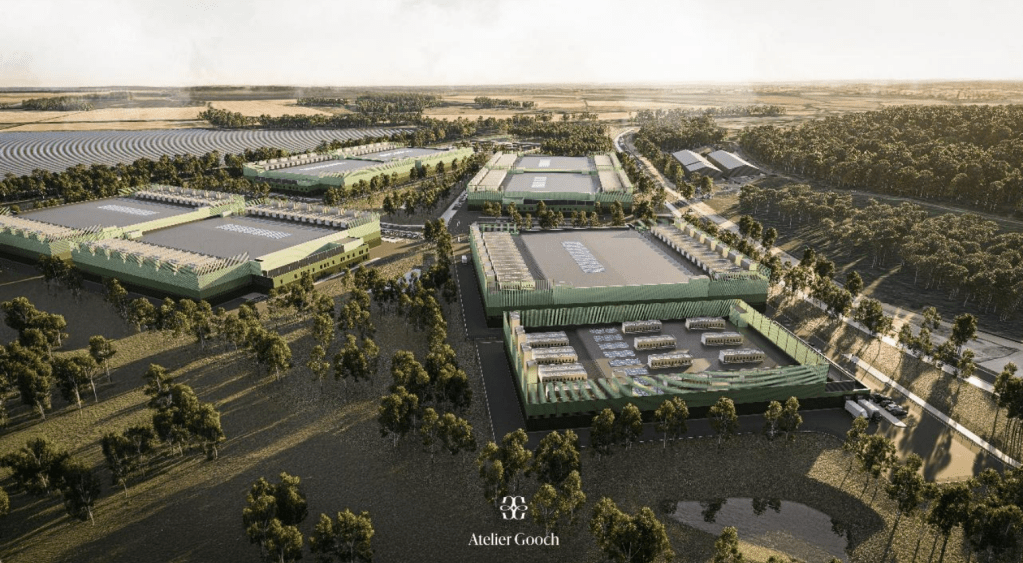
CGI view of the proposed data centre [1]
At a Glance
A planning application has been submitted for a large-scale data centre at Graven Hill. If approved, this would be one of the largest facilities of its kind in the UK.
In very simple terms, a data centre is a warehouse full of servers that store your photos and run other digital ‘cloud’ services such as the apps on your phone. Unlike a typical warehouse though, they use large amounts of power and generate substantial heat, which can have local environmental effects that need careful management.
National planning policy supports this type of development, and data centres are viewed as critical infrastructure by the government. The proposal itself appears to be a better example of its kind. Nonetheless, potential issues have been identified concerning anticipated noise levels near planned future homes on the south-eastern side of Graven Hill. A number of other points also require clarification.
The Graven Hill Residents’ Association is reviewing the proposal and will submit formal feedback before the 18th April deadline.
What is the proposal and why does it matter ?
We recently informed residents of a Reserved Matters Planning Application (25/03310/REM) for a very large data centre on the employment land at Graven Hill [2]. The site is on the south-eastern side of the hill, adjacent to St David’s Barracks.
The data centre would be one of the largest in the UK and will have an energy demand roughly equivalent to that of one million homes as specifically mentioned in the application [3].
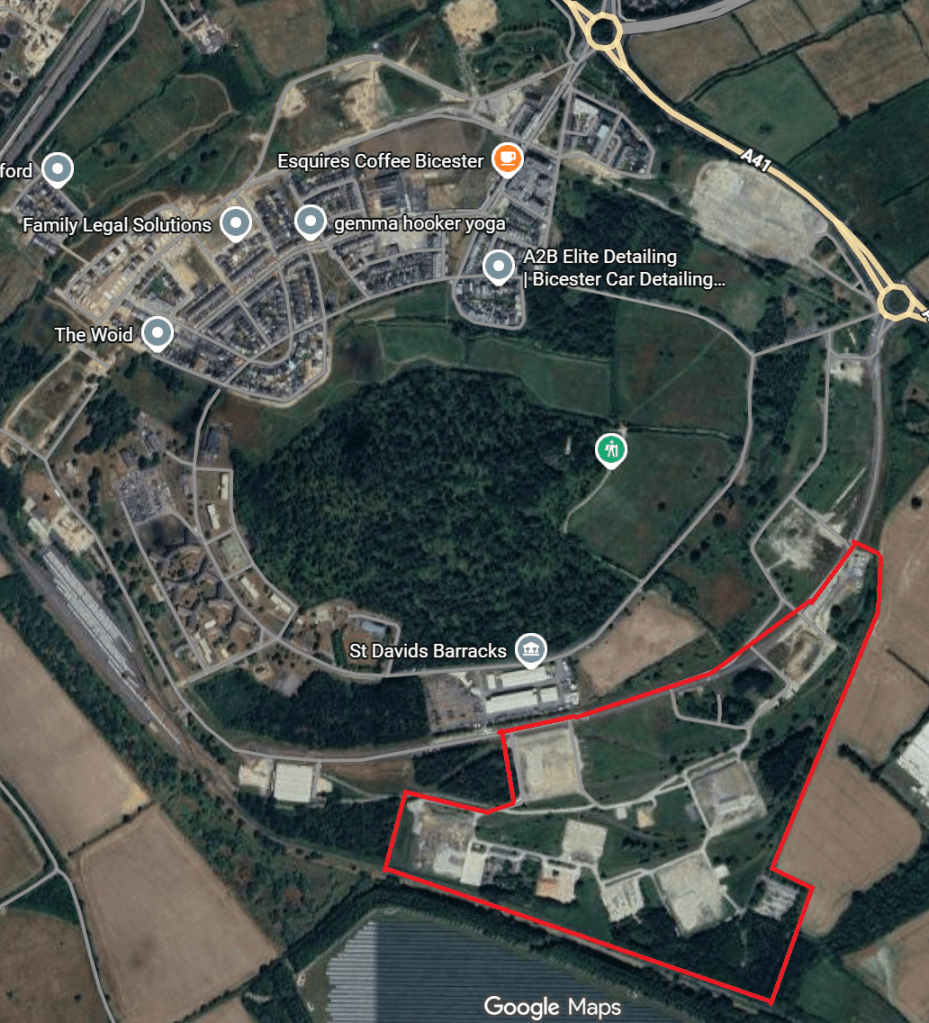
Google Maps image of Graven Hill with proposed data centre site highlighted in red.
Sites of this size require consideration of factors such as heat, noise, air pollution, water consumption, and power requirements. This makes it important to understand what this proposal means for Graven Hill, and especially those living nearby. At the same time, any considerations should include potential benefits of the project too, including employment opportunities and fewer heavy vehicle movements than would be expected from a traditional warehouse or fulfilment centre.
This proposal also sits within a wider national conversation about how data centres are built and powered. Its sustainability implications are especially debated for the larger examples, often referred to as hyperscale data centres [4].
Residents may have their own views on these issues. However, the focus of the Graven Hill Residents’ Association (GHRA) must focus on how this specific proposal might affect our local community and neighbourhood. From this perspective, we are not opposed to the idea of a data centre in principle, but we do want to ensure we all understand the issues at hand, that any and all appropriate mitigation measures are in place, and that community benefits are optimized.
What could this mean for Graven Hill ?
The GHRA engaged with councillors and other relevant parties with domain experience and expertise. We also met recently with the applicant and data centre developer, Graven Hill Purchaser Ltd. The following reflects some of the key issues discussed:
Power
One of the defining features of the proposal is its sheer scale. It is difficult to get one’s head around a data centre consuming the same power as roughly one million homes. It is not a question how the data centre will run, but how that power demand is managed without there being a wider impact on the community. For example, residents may be aware that other developments in the area have been delayed by challenges with the grid infrastructure, so questions about feasibility are understandable and appropriate [5][6].
In our discussions, the developer indicated they had already secured a contract to supply the power needed. Although the developer was not willing to discuss the details of this contract, it is likely good news as it reduces the possibility of onsite power generation, such as gas turbines, which would add noise and emissions. The developer also mentioned reinforcements to the power infrastructure, which could benefit the wider area, though details were limited and further clarity would be helpful. However, the nature of this power contract perhaps needs further exploration to establish their planned contingency should the contracted power supply not materialize for whatever reason.
Managing such large energy demands leads naturally to questions about cooling, water use and potential heat reuse.
Cooling, Water & Heat Reuse
Cooling is to be achieved using a combination of “free cooling” – similar in principle to an air-source heat pump running in reverse – and mechanical coolers. The system uses very little water, which is contained within a closed-loop design typical of modern data centres [7][8].
Mechanical coolers will operate to varying degrees when free cooling is insufficient (approximately 40% of the year) and this brings us onto the next issue: noise.
Almost all the energy used turns into heat. In theory, it could be reused to warm nearby homes, commercial buildings, or greenhouses. The application mentions this as a possibility but leaves it to others to take on the initiative. Without clear national or regional policy, or requirements imposed within the permit, there is no clear route for that to happen in this development, and meaningful heat reuse at Graven Hill is unlikely [9][10].
Noise
A Noise & Vibration Assessment modelled impact at 10 locations around Graven Hill [11]. Most were within acceptable limits. However, the location closest to the data centre, showed an adverse impact on the edge of the Stage 2 development planned by the Graven Hill Village Development Company (GHVDC). This means some future homes here may be affected by noise, especially at night [12]. The data centre developer did not provide further clarification on this point, so the GHRA will request appropriate mitigation measures are in place.
A technical detail of practical importance is the assumption that there is no significant ‘tonal component’ to the noise. Tonal components relate to the specific volume of specific frequencies (tones) rather than overall volume. Even a small tonal component – such as a persistent hum or whistle or whining – can be more noticeable and intrusive than general background noise at the same or lower volume levels [13].
If tonal effects are present, the modelled impact would be greater than the assessment suggests. This impact may extend beyond this location to other nearby homes, including some outlying properties in Ambrosden. This has been flagged to Ambrosden Parish Council, and we are asking for guidance from the Environmental Health Officer at Cherwell District Council (CDC) [14][15].
Importantly, based on current understanding of the site and local geography, existing residents at Graven Hill are not expected to be affected.
Lighting & Ecology
Lighting for the data centre campus was assessed in a Lighting Impact Assessment [16]. This generally appeared to be satisfactory apart from the fact it did not account at all for future Stage 2 housing development at Graven Hill [17]. We will follow up to ensure future homes are properly considered.
Lighting has also been reviewed alongside ecological considerations, including input from the Bat Conservation Trust. Mitigation measures already enacted include a bat barn and additional bat boxes [18].
The Ecological Impact Assessment does not identify any other significant impacts on local wildlife [19]. However, the release of heat during normal operations and the microclimate this might create is not specifically addressed. Although any local impact is expected to be minor, we will request it be formally considered for completeness.
Employment
The developer anticipates between 500 and 800 jobs once this site is fully operational. Around half of these positions are expected to be remote workers which means that a significant number may not be based locally [20].
The actual number of jobs depends on how the data centre is operated. A single large operator would typically require fewer staff due to economies of scale, whereas multiple operators across the site could increase the number of jobs. In practical terms, while the overall figures for jobs and economic benefits appear substantial, the benefits locally may prove to be more limited [21].
Mention is also made of an Employment Skills and Training Plan including apprenticeship schemes which may benefit the local community. Further details are needed to establish its proposed scope and to ensure it is a locked-in obligation [22].
Planning Process
Data centres are considered “critical national infrastructure” and are prioritised in the National Planning Policy Framework [23][24]. They are classified as ‘B8 storage/warehouses’, even though their actual function differs significantly from other examples in this category. This highlights a broader question as to whether UK Planning Categories have kept pace with technology, with some voices advocating for a dedicated new category for data centres [25].
In this case, Planning Officers at CDC agreed to consider the proposed data centre within the B8 category during pre-application discussions [26]. Following on from this, without any official change of use, standard processes were followed, and wider public consultation was therefore not considered mandatory.
We have made separate representations to the Planning Officer and the Head of Planning at CDC seeking a wider engagement and await their reply.
In our discussions with the developer, we advocated for a town hall meeting with residents to provide a wider opportunity for engagement. While happy to discuss matters with the GHRA directly, they declined that option at this time, referring us back to the formal process for comments for this planning application.
The original Outline planning permission (22/01829/OUT) listed 47 conditions that must be met by the developer, which remain relevant to the proposed use of the site as a data centre [27]. The first condition requires that all reserved matters are submitted within three-years from the original permission, which expires in October this year. The developer has confirmed that this planning application addresses all reserved matters.
Next Steps
The GHRA is preparing a formal response to the Reserved Matters application based on resident feedback and the research and discussions we have undertaken. This will be submitted well before the 18th April deadline and shared with residents, along with guidance on how to submit your own feedback if you so wish.
In the meantime, we continue to monitor key issues raised during our discussions and will follow up where clarification is still needed.
Conclusion
National planning policy is broadly supportive of data centres, so the key question here is less whether it should exist and more how it affects people locally.
As part of our research, we also spoke with Foxglove, an independent non-profit known for taking a sceptical view of the tech sector and large-scale data centres [28]. Their view was that, while data centres raise valid concerns, this proposal is not among the more problematic examples they have come across. This partly reflects the positive design choices, particularly the use of free cooling and minimal reliance on water.
Furthermore, even if the data centre developer declared all energy demands were to be met by renewable means, this would likely be cosmetic. To be a substantive green credential, this would require incremental renewable capacity to be provided and not simply energy supply redirected from existing capacity [29].
So, whilst this is a complex topic, the position becomes straightforward:
- The principle aligns with national policy.
- The proposal appears to be a reasonable example of its kind.
- Impacts felt locally – such as noise – are where scrutiny should be focussed on.
Final Word
In this blog, the focus has been on what we believe are the primary issues most relevant to residents, reflecting the broad thrust of what we are likely to raise in our feedback [30]. This position is not yet finalised, so if you have questions, observations or insight on any of the matters discussed, please do get in touch. Your input is valuable and helps us ensure that the community’s voice is accurately represented.
Notes & Further Reading
[1] H Planning Ltd., (2025) Reserved Matters Planning Statement. Prepared for Graven Hill Purchaser Ltd. Supporting Document to planning application 25/03310/REM. Available at: https://planningregister.cherwell.gov.uk/Document/Download?module=PLA&recordNumber=165246&planId=2405224&imageId=7&isPlan=False&fileName=D1%20Site%20Graven%20Hill%20Reserved%20Matters%20Statement%20December%202025%20Final%20PDF.pdf (figure 1.7, p.16).
[2] Graven Hill Purchaser Ltd., (2025) Reserved Matters Planning application 25/03310/REM, Cherwell District Council Planning Portal, https://planningregister.cherwell.gov.uk/Planning/Display/25/03310/REM#undefined
[3] SLR Consulting Ltd., (2025) Energy Statement & Renewables Feasibility Report. Prepared for Graven Hill Purchaser Ltd. Supporting Document to planning application 25/03310/REM. Available at: https://planningregister.cherwell.gov.uk/Document/Download?module=PLA&recordNumber=165246&planId=2405226&imageId=9&isPlan=False&fileName=Graven%20Hill%20Energy%20Statement_Renewables%20Feasibility%20Report_Final.pdf (section 14.3, p.60).
“For reference the regulated demand for the site has been estimated to be 4,265MWh/yr and the unregulated demand is estimated to be 3,805,735MWh/yr. The total energy demand is therefore 3,810,000MWh, approximately equivalent to 1,038,707 average Oxfordshire homes”
[4] Kleinman, Z. and Shveda, K. (2025) ‘Data centres to be expanded across UK as concerns mount’, BBC News, 15 August. Available at: https://www.bbc.co.uk/news/articles/clyr9nx0jrzo .
[5] Cherwell District Council (2025) Cherwell District Housing Delivery Action Plan 2025: Appendix 1. Available at: https://modgov.cherwell.gov.uk/documents/s59523/Appendix+1+-+Draft+CDC+Housing+Delivery+Action+Plan+May+2025.pdf (section 6.1, p.13).
“One of the biggest issues to delivery at Bicester has been ensuring sufficient electricity supply to meet the demands of the growing town. A number of sites have stalled as capacity in the grid to serve the homes is not there and not anticipated for a number of years. This has affected confidence of the housebuilders on some sites to start building if the houses cannot connect to the grid.”
[6] Morby, A. (2025) ‘Grid delays now rival planning as chief threat to project delivery’, Construction Enquirer, 29 July. Available at: https://www.constructionenquirer.com/2025/07/29/grid-delays-now-rival-planning-as-chief-threat-to-project-delivery/ .
“Turner & Townsend’s latest tender price forecast warns that access to power has become a key battleground for construction, with demand surging and infrastructure projects facing long delays in securing connections. National Grid estimates that the UK’s total electricity demand will rise by 50% in just 10 years – and double by 2050. One of the biggest contributors is the explosion in new data centres, whose power-hungry servers drive everything from cloud storage to artificial intelligence.”
[7] Vertiv (no date) A beginner’s guide to data centre cooling systems. Available at: https://www.vertiv.com/en-asia/about/news-and-insights/articles/educational-articles/a-beginners-guide-to-data-center-cooling-systems .
[8] Williment, C. (2025) ‘How are companies pioneering data centre zero water cooling?’, Sustainability Magazine, 22 July. Available at: https://sustainabilitymag.com/news/how-are-companies-pioneering-data-centre-zero-water-cooling .
[9] techUK (2024) Warming up to efficiency: understanding the potential benefits and pitfalls of data centre heat export in the UK. Available at: https://www.techuk.org/resource/warming-up-to-efficiency-understanding-the-potential-benefits-and-pitfalls-of-data-centre-heat-export-in-the-uk.html .
[10] EnergiRaven (2026) Enough Data Centre Heat for 6 Million Homes. Available at: https://www.energiraven.com/enough-heat-for-6-million-homes/
[11] BWB Consulting (2025) Noise and Vibration Assessment – Graven Hill Data Centre. Prepared for Graven Hill Purchaser Ltd. Supporting Document to planning application 25/03310/REM. Available at: https://planningregister.cherwell.gov.uk/Document/Download?module=PLA&recordNumber=165246&planId=2405247&imageId=30&isPlan=False&fileName=D1%20Site_Noise%20and%20Vibration%20Assessment_Final.pdf
[12] The 10 locations for noise monitoring are shown in Figure 1 (p.11). Results are summarised for normal operations, routine testing and emergency situations in Tables 10, 11 & 12 (pp.19, 21 and 22).
Under the BS 4142 methodology, an adverse impact is typically identified at around +5dB above background levels, with a significant adverse impact at around +10dB.
The assessment indicates that significant adverse impacts occur at one location (NSR G), situated at the edge of the planned Stage 2 housing area within the GHVDC masterplan. These impacts are identified during emergency operation and during routine testing at night.
Emergency operation is described as “exceptional” and “infrequent”, and on this basis no additional mitigation is proposed. The assessment also notes that residential development in this location is not yet approved, although it acknowledges the presence of the GHVDC masterplan and the likelihood of future housing in this area.
Given that the assessment itself identifies scenarios in which significant adverse impacts may occur adjacent to planned residential areas, it would be reasonable to expect that further mitigation measures are secured through planning conditions. In particular, this would be managed by restrictions on routine testing at night and confirmation of how emergency operations might be managed to minimise impact.
Further clarification is also required on how the assessment moves from identifying a ‘low impact’ under the BS 4142 methodology to describing effects as “negligible”, as these terms are not directly equivalent within the standard.
[13] The Noise and Vibration Assessment states: “Noise emissions are expected to be broadband and steady in character, with no specific acoustic features likely to attract attention on that basis” (Section 6, p.18). The use of the word “expected” indicates that this is an assumption rather than a conclusion based on measured evidence.
If a tonal component were to be present, a further adjustment, or ‘character correction’, would be applied under the BS 4142 methodology. This would typically be at least +2dB in addition to the +3dB already applied, and potentially up to a +7dB depending on the characteristics of the noise.
In such circumstances, impacts at receptor locations (including NSR C, H, I and J) could increase beyond those currently reported under certain operating scenarios.
Tonal components associated with mechanical plant and cooling systems are not uncommon in data centre environments[14]. By way of comparison, planning permission for a large data centre at South Mimms required the developer to demonstrate the absence of tonal characteristics to avoid the application of a +10dB correction [15].
See the following spreadsheet for more details: https://gravenhillra.com/wp-content/uploads/2026/04/data-centre-noise-projections.xlsx
[14] Industrial Noise & Vibration Centre (2025) Data Centre Noise Control: Tonal Noise and Cooling Systems. Available at: https://invc-media.s3.amazonaws.com/invc_website/media/documents/Data_Centre_Noise_Control.pdf (pp. 2-5, 8).
[15] Hertsmere Borough Council (2023) Decision Notice: Application No. 23/1049/OUT. Borehamwood: Hertsmere Borough Council. Available at: https://www6.hertsmere.gov.uk/online-applications/files/08FE9701FEA25AAC103B78EBD664AC74/pdf/23_1049_OUT-DECISION_NOTICE-1840613.pdf (condition 14).
[16] BWB Consulting (2025) Graven Hill D1 Site, Bicester: Lighting Impact Assessment. Prepared for Graven Hill Purchaser Ltd. Supporting Document to planning application 25/03310/REM. Available at: https://planningregister.cherwell.gov.uk/Document/Download?module=PLA&recordNumber=165246&planId=2405242&imageId=25&isPlan=False&fileName=D1%20Site_Lighting%20Impact%20Assessment%20Part%201%20Final.pdf
[17] In Figure 2 on p14 of the Lighting Impact Assessment, the future Stage 2 housing development at Graven Hill is not acknowledged. This is compounded by the statement “The closest residential properties are in the village of Ambrosden” in section 5.35 on p.21, which would no longer be the case should the site be developed as expected.
[18] Bat considerations discussed on pages 8-10 and 19-20 of the Lighting Impact Assessment. Also discussed along with other wildlife species in section 2.2.9 and 6.3.24 of the Ecological Impact Assessment [19].
[19] Tetra Tech RPS (2025) Graven Hill II Ecological Impact Assessment. Prepared for Graven Hill Purchaser Ltd. Supporting Document to planning application 25/03310/REM. Available at: https://planningregister.cherwell.gov.uk/Document/Download?module=PLA&recordNumber=165246&planId=2405317&imageId=50&isPlan=False&fileName=D1%20Site%20Ecological%20Impact%20Assessment%20Final.pdf
[20] Quod (2025) Graven Hill, D1 Site, Bicester: Economic Benefits Statement. Prepared for Graven Hill Purchaser Ltd. Supporting Document to planning application 25/03310/REM. Available at: https://planningregister.cherwell.gov.uk/Document/Download?module=PLA&recordNumber=165246&planId=2405225&imageId=8&isPlan=False&fileName=D1%20Site_Economic%20Benefits%20Statement_Nov%202025_Final.pdf
[21] In addition to the mention of the number of onsite jobs in sections 6.10, p.22 and 6.15, p.23 of the Economics Benefits Statement, the document also claim an economic benefit of £225M to £630M to Oxfordshire in section 6.27 on page 24. Clarity is required to establish how much of this benefit is retained within the area versus how much ‘leaks’ away to suppliers and employees outside the region.
[22] Reference is made in section 5.26 on p.20. Ideally, “seeks” would be replaced here with “requires”, although this is also understood to be a work in progress.
[23] Department for Science, Innovation & Technology (2026) Data centres. Policy Paper for UK Government. Available at: https://www.gov.uk/government/publications/cyber-security-and-resilience-network-and-information-systems-bill-factsheets/data-centres#:~:text=Data%20centres%20host%20and%20support,cyber%20security%20or%20operational%20resilience.
“Data centres host and support the digital infrastructure that underpins modern life – from patient records and emails to product data and financial systems. They are critical to nearly all economic activity and public services, and were designated as critical national infrastructure in 2024, putting data centres on an equal footing as water, energy and emergency services systems”
[24] Ministry of Housing, Communities & Local Government (2024) National Planning Policy Framework. Available at: https://assets.publishing.service.gov.uk/media/67aafe8f3b41f783cca46251/NPPF_December_2024.pdf (section 86c, p.24).
“Planning policies should […] pay particular regard to facilitating development to meet the needs of a modern economy, including by identifying suitable locations for uses such as […] data centres.”
[25] RPS Group (2026) Planning permission for data centres: The Use Class explained. Available at: https://www.rpsgroup.com/insights/consulting-uki/planning-permission-for-data-centres-the-use-class-explained/#:~:text=to%20use%20them.-,The%20Storage%20Solution%20%E2%80%93%20B8,including%20remote%20multiple%2Duser%20access.
[26] See section 1.7 of the Reserved Matters Planning Statement [1].
[27] Cherwell District Council (2023) Notice of Decision: Town and Country Planning Act 1990 (As Amended). Application No.: 22/01829/OUT. Available at: https://planningregister.cherwell.gov.uk/Document/Download?module=PLA&recordNumber=151455&planId=2066411&imageId=357&isPlan=False&fileName=Decision%20Notice_2201829OUT.pdf
[28] Foxglove (2026) Foxglove teams up with FT to debunk the Government’s dodgy AI Growth Zone job creation claims. Available at: https://www.foxglove.org.uk/2026/01/30/foxglove-ft-debunk-ai-growth-zone-job-claims/ – an example article taken from their website.
[29] Milmo, D. (2026) ‘Datacentre developers face calls to disclose effect on UK’s net emissions’, The Guardian, 1 March. Available at: https://www.theguardian.com/technology/2026/mar/01/datacentre-developers-energy-greenhouse-gas-emissions
[30] The developer suggested a number of questions asked of them by the GHRA were submitted via the Planning process. Not all of these had a direct bearing on the community but asked purely to understand more about the proposal and out of general interest. For example, the developer indicates that the data centre is aiming for the BREEAM ‘Excellent’ rating as stipulated in the Condition 39 of the Outline permission. This is a positive step but is caveated and appears to be an aspiration rather than a guaranteed outcome. It remains unclear what the implications would be if this standard is not achieved, or whether additional measures could offset the site’s energy demand?
 Graven Hill Residents' Association